Most people assume that once a magistrate commits a matter to a higher court, a trial is inevitable. It isn’t. NSW criminal law includes a procedural mechanism that can bring a prosecution to a close before it ever reaches a jury — the no bill application. Few members of the public have heard of it, and many accused people are never told it exists. At Harvard Defence Lawyers, we treat it as a genuine strategic option in the right case, not a long shot.
The Short Version
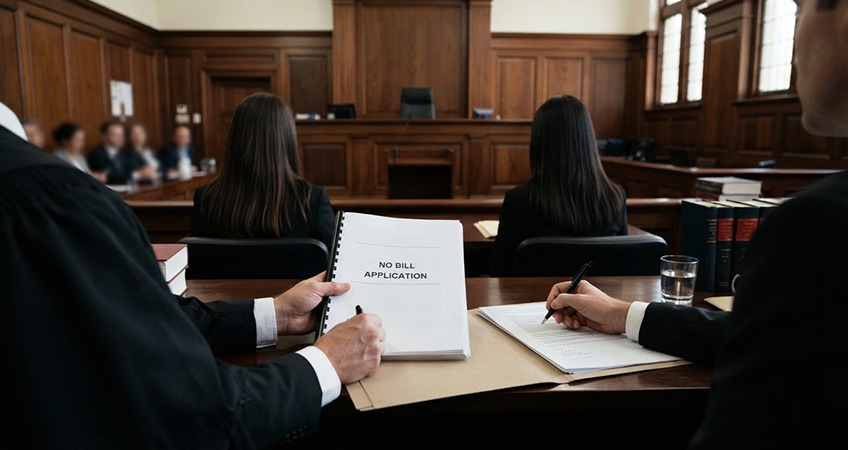
A no bill application is a written submission to the Office of the Director of Public Prosecutions (ODPP), asking the DPP to exercise its discretion not to file an indictment after a person has been committed for trial. If the DPP agrees, the matter is discontinued — the accused does not stand trial on that charge.
This is different from being found not guilty. There is no verdict, no jury, and technically the DPP retains a narrow power to revive proceedings later, though this is uncommon in practice. What a successful no bill delivers is the end of the immediate prosecution, achieved through legal argument rather than a courtroom contest.
Where It Sits in the Court Process
To understand a no bill application, it helps to place it on the timeline:
- Charge and summary hearing – the matter starts in the Local Court.
- Committal – for indictable offences, a magistrate decides whether there is enough evidence for the matter to proceed to a higher court (the District or Supreme Court).
- Indictment stage – once committed, the Crown must formally file an indictment before a trial can be listed.
- Trial – the matter is heard before a judge and jury (or judge alone in some circumstances).
A no bill application sits between steps 3 and 4. It’s a last opportunity, before the indictment is filed, to persuade the Crown that the case should not go further.
Why the DPP Would Ever Agree
The ODPP doesn’t prosecute every case that survives committal. Under its own Prosecution Guidelines, every decision to proceed with a serious charge must satisfy two separate tests:
- The evidentiary test — is there a reasonable prospect that a jury, properly instructed, would convict on the available evidence?
- The public interest test — even if the evidence clears that bar, does prosecuting actually serve the public interest?
A no bill submission is really an argument that one or both tests fail. Common grounds include:
- A key prosecution witness whose account is internally inconsistent, contradicted by other evidence, or otherwise unreliable
- Identification evidence that doesn’t meet accepted standards
- Expert or forensic evidence that can be shown to be flawed or overstated
- Legal elements of the charge that the Crown simply cannot make out on the facts
- Genuine public interest factors — for example, the accused’s serious ill health, extreme delay in bringing the matter to trial, or the disproportion between the alleged conduct and the cost of a full prosecution
What Actually Goes Into an Application
There’s no hearing. No bill applications are decided entirely on the papers, usually by a senior Crown prosecutor. That makes the written submission the whole case — every argument has to be made clearly and persuasively in writing, because there’s no opportunity to respond to questions on the spot the way there would be in court.
A properly prepared application typically works through:
- A close review of the committal brief and transcript, identifying every weakness in the Crown’s evidence
- Legal submissions on why those weaknesses are fatal to the prospect of conviction, not just points that might be argued at trial
- Supporting material — witness statements, expert reports, medical evidence, or character references — where public interest factors are being raised
- A clear, structured argument rather than a scattergun list of objections
This is not a document to draft casually. A weak or poorly reasoned no bill application can backfire — it shows the Crown exactly how the defence intends to attack the case, which can sharpen the prosecution’s trial preparation if the application fails.
Timing Is Everything
No bill applications work best when they’re lodged promptly after committal, before the Crown has invested heavily in trial preparation and while the file is still relatively fluid. An application filed close to a listed trial date is a much harder sell — by then the ODPP has already committed resources, and the calculus around public interest shifts against discontinuing.
If a no bill strategy is on the table, the conversation with your lawyer needs to happen early — ideally in the days immediately following committal, not weeks later.
If the Application Is Refused
A refusal doesn’t close off every avenue. The Crown files its indictment and the matter proceeds toward trial, but other procedural tools remain available, including applications to exclude particular evidence before a jury ever hears it. In many matters, defence teams also continue discussions with the Crown about narrowing charges as trial preparation progresses. A refused no bill is a setback, not necessarily the end of the road.
Does This Apply Outside NSW?
No bill applications exist in a similar form in Victoria and Queensland, wherever a committal system feeds indictable matters into a higher court. The exact process, the guidelines applied, and the DPP’s internal practices differ between states, so a strategy built around NSW’s ODPP Prosecution Guidelines won’t necessarily translate elsewhere without adjustment.
Is a No Bill Application Right for Your Matter?
Not every committed matter is a candidate. Where the Crown case is genuinely strong and the real dispute is a factual one for a jury to resolve, a no bill submission is unlikely to succeed — and filing one anyway can hand the prosecution a preview of the defence case for no real benefit.
Where it’s called for is when there’s a specific, identifiable weakness in the evidence: something concrete a lawyer can point to and argue, not just a general sense that the case feels thin. Working out which category your matter falls into takes an honest, experienced assessment of the brief — not optimism.
Harvard Defence Lawyers provides relentless defence and trusted advocacy across Sydney, with offices in Blacktown, Liverpool/Belmore, and the CBD. If you’ve been committed to stand trial and want an honest opinion on whether a no bill application is worth pursuing, our team is available 24/7 on a transparent, fixed-fee basis to review your matter.