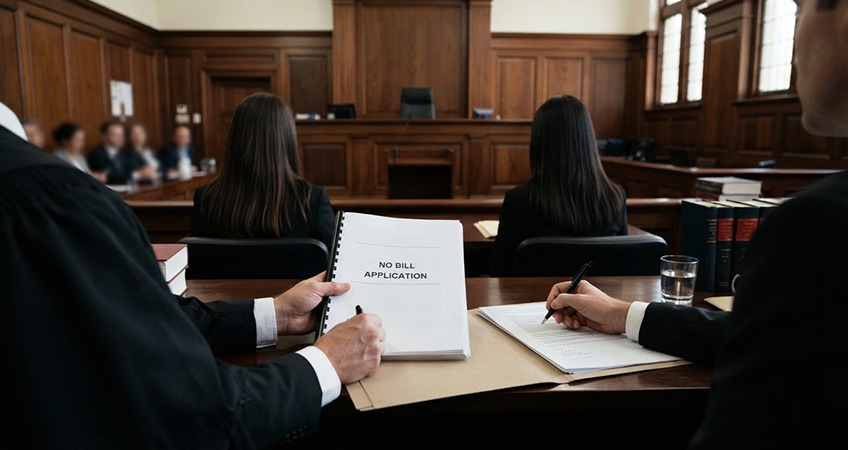
If you are facing a serious criminal charge in New South Wales, you may have the option to have your matter heard by a judge alone, rather than by a jury. This choice can significantly affect how your case is run, how the evidence is assessed, and ultimately the outcome of your trial. Understanding when a judge alone trial is available, and whether it is the right strategic choice, is an important part of preparing a strong defence.
What Is a Judge Alone Trial?
In the NSW District and Supreme Courts, most indictable offences are ordinarily tried before a jury of twelve members of the public. A judge alone trial removes the jury from the equation entirely. Instead, a single judge hears all the evidence, applies the relevant law, and delivers both the verdict and the reasons for it.
This is a fundamentally different process to a conventional trial. Rather than a jury retiring to deliberate in private, the judge must provide written reasons explaining exactly how each piece of evidence was weighed and why a particular conclusion was reached on each element of the offence.
The Legal Basis
Judge alone trials in NSW are governed by the Criminal Procedure Act 1986 (NSW), particularly section 132. Under this framework, either the prosecution or the accused may apply to have a trial conducted without a jury, but the accused’s consent is always required — a judge alone trial cannot be forced upon a person who wants a jury trial.
The court retains discretion over whether to grant the application. A judge alone trial will generally be ordered where both parties consent, unless the court considers it is not in the interests of justice to do so. Where only the accused applies and the prosecution objects, the court must be satisfied that it is in the interests of justice to proceed without a jury, having regard to factors such as the complexity of the case, the nature of the evidence, and whether there is a risk that a jury could be improperly influenced by extensive media coverage or other prejudicial material.
Why an Accused Might Choose a Judge Alone Trial
There are several circumstances in which electing for a judge alone trial can be a sound strategic decision:
- Complex or technical evidence. Matters involving detailed forensic, financial, or expert evidence can be more reliably assessed by a legally trained judge than by a lay jury asked to absorb large volumes of specialised material in a short period.
- Extensive pre-trial publicity. Where a case has attracted significant media attention, there is a risk that jurors may be influenced by information outside the courtroom. A judge is trained to disregard such material and decide the matter solely on the admissible evidence.
- Legally complicated defences. Some defences turn on fine legal distinctions — for example, issues of intent, causation, or the admissibility of particular evidence — that may be better navigated by a judge than left to a jury’s general impression of fairness.
- Reasoned verdicts. Because a judge must give written reasons for the verdict, there is a clear record of the reasoning process. This can be significant if an appeal becomes necessary, as it allows appellate courts to scrutinise the specific findings that led to a conviction or acquittal.
- Multiple or repeat trials. In cases where a previous jury has been discharged, or where a retrial is required, a judge alone trial can avoid the delay, cost, and uncertainty of empanelling a fresh jury.
Potential Disadvantages
A judge alone trial will not suit every case. Some considerations that may weigh against it include:
- Loss of the “community verdict.” A jury represents a cross-section of the community and can sometimes be more sympathetic to circumstances that a judge, bound strictly by legal principle, may not weigh in the same way.
- No majority verdict flexibility. A jury can occasionally reach a majority verdict where permitted; a judge alone trial requires the judge to reach a single, unanimous-equivalent conclusion.
- Perceived predictability. Some practitioners consider that jurors, deliberating collectively, may bring a broader range of perspectives to ambiguous evidence than a single decision-maker.
Whether these factors are relevant depends entirely on the individual facts of the case, which is why this decision should never be made without detailed advice from an experienced criminal defence lawyer.
The Application Process
An application for a judge alone trial must be made before the trial begins, and both the prosecution and defence are given the opportunity to make submissions. The court will consider matters including:
- Whether both parties consent to the application
- The complexity of the legal and factual issues involved
- The extent and nature of any pre-trial publicity
- The likely length and structure of the trial
- Any other matter the court considers relevant to the interests of justice
If the application is contested, the court will hand down a ruling setting out its reasons before the trial proceeds in whichever form has been determined.
Getting the Right Advice Early
The decision to pursue a judge alone trial is one of the most significant strategic choices in a criminal defence case, and it should be made only after a thorough review of the brief of evidence, the strength of the prosecution case, and the specific issues likely to arise at trial.
At Harvard Defence Lawyers, our solicitor-advocates regularly appear in the NSW District and Supreme Courts and advise clients on whether a judge alone trial is likely to serve their interests. If you are facing an indictable charge and want to understand your options, contact our team for confidential advice, available 24/7 across our Sydney CBD, Blacktown, and Liverpool/Belmore offices.
This article is intended for general information purposes only and does not constitute legal advice. Every case turns on its own facts, and you should seek advice specific to your circumstances before making any decisions about your matter.